Determining Speaker Requirements for 200 Person Events
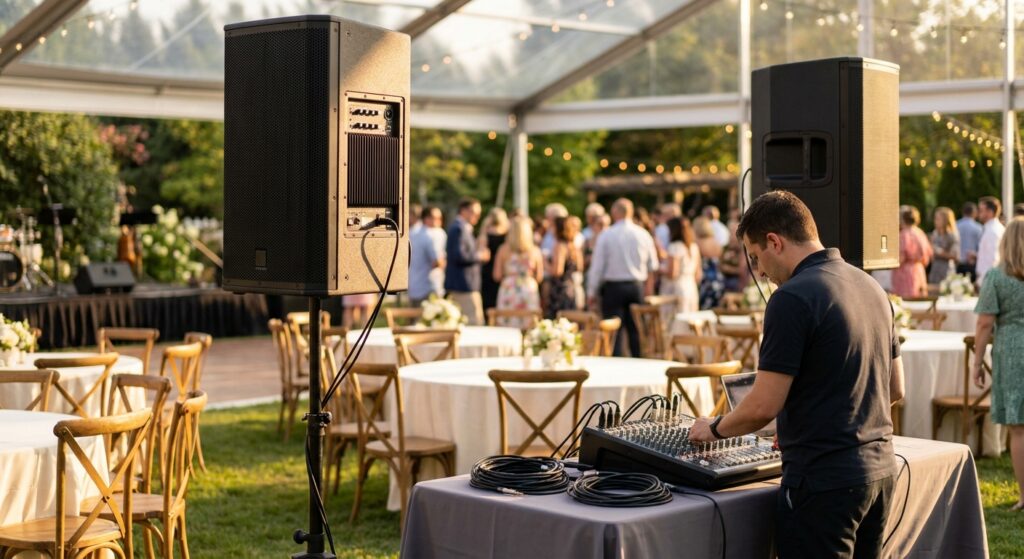
When determining speaker requirements for 200 person events, you generally need two 12-inch or 15-inch point-source speakers to maintain adequate sound pressure levels (SPL) across the room. This configuration provides the baseline coverage necessary for standard medium-sized venues where the audience is concentrated. Adding a single 15-inch or 18-inch subwoofer is often necessary if the event includes music, dancing, or high-energy presentations. If the room layout is narrow or exceptionally deep, your speaker count should increase to four to prevent significant volume drop-off at the rear of the space. When planning your technical layout, we recommend referring to our ultimate event audio checklist to ensure no critical technical elements are overlooked.
Speaker Requirements and Hardware Scaling
To ensure consistent audio coverage, you must match your hardware to the scale of your event. The following table provides a general guide for speaker configurations based on typical venue capacity and application:
| Event Size | Primary Speakers | Subwoofer Recommendation | Power Requirement (Peak) |
|---|---|---|---|
| 50–100 Guests | 2 x 10″ or 12″ Active | Optional (1 x 15″) | 800W+ |
| 200 Guests | 2 x 12″ or 15″ Active | Required (1 x 15″ or 18″) | 1500W+ |
| 300+ Guests | 4 x 15″ (or Line Array) | Multiple (2 x 18″) | 3000W+ |
Acoustics and Sound Dispersion
Sound waves dissipate according to the inverse square law, a fundamental principle of physics established by Audio Engineering Society standards. This law dictates that sound intensity drops by 6dB for every doubling of distance from the source. In a room with 200 people, the human bodies act as acoustic absorbers that soak up high frequencies. To combat this, you must position speakers above head height (at least 2 metres) to ensure the sonic energy reaches the back of the room without being obstructed by the audience.
Effective sound design prioritizes direct sound over reflected sound. Key factors influencing your setup include:
- Horizontal dispersion: Angles must cover the full width of the seating area.
- Vertical tilt: Proper angling minimizes ceiling reflections and late echoes.
- Crossover management: Ensuring a smooth handover between tops and subs near the 60Hz-80Hz range for full-range clarity.
Power Management and Electrical Safety
In South African venues, managing the power supply is as critical as the audio signal itself. Erratic power quality can impact digital signal processors and sensitive mixing consoles. We adhere to strict power management protocols to prevent voltage fluctuations from damaging hardware or causing system resets during events. As per standard electrical safety practices, ensure your power distribution aligns with your local SANS 10142-1 requirements for electrical installations.
For mission-critical audio, we utilize:
- Pure sine wave inverters: To maintain a clean, stable current for digital signal processing.
- Surge protection units: Essential for preventing damage from grid spikes or switching intervals during load-shedding.
- Uninterrupted Power Supply (UPS) units: To provide a buffer for digital mixing consoles, ensuring they do not drop signal during short power interruptions.
Deliver Crystal-Clear Audio to Every Guest
If you are planning an event and need professional guidance on equipment scaling or power reliability, reach out to our team today for a tailored technical consultation. Whether you are choosing the right sound system for outdoor events or learning about the complexities of live band vs DJ sound setup requirements, we ensure every guest experiences clear, distortion-free audio.
FAQ’s
Is one speaker enough for 200 people?
No, a single speaker cannot provide even coverage for 200 people. You will likely experience “hot spots” near the front while the sound becomes inaudible at the back. Dual speakers are the minimum standard required to create a balanced stereo image.
Do I need subwoofers for a 200-person event?
Yes, if your event involves music, dancing, or cinematic video presentations. Point-source speakers typically lack the cone surface area required to reproduce frequencies below 60Hz effectively, leading to a thin, “tinny” sound profile.
How does ceiling height affect speaker choice?
Low ceilings increase the risk of feedback and harsh reflections, requiring more speakers at lower volumes to maintain clarity. High ceilings allow for better dispersion but may require delay stacks to ensure the sound reaches the back of the room without significant echo.
Can I use outdoor speakers for an indoor event?
While possible, outdoor speakers are engineered for “long-throw” applications and can sound overly aggressive or harsh in enclosed spaces. Indoor environments generally benefit from speakers with wider dispersion patterns designed for reflection control.