The Ultimate Event Audio Checklist: Everything You Need for Flawless Sound
Your event’s success is contingent on intelligible, clean audio. The definitive route to achieving this requires methodical pre-event venue assessment, selection of professional-grade hardware aligned with your objectives, and a rigorous, systematic sound check protocol. Anything less introduces unnecessary operational risk.
Pre-Event Planning: Assessing Your Venue’s Acoustic Needs
Before a single piece of equipment is loaded, a comprehensive site survey is non-negotiable. This process forms the foundation of your entire audio strategy, identifying and mitigating potential issues before they can affect your event. We analyse the venue’s inherent acoustic properties, such as reverberation times and standing waves, which can severely impact speech intelligibility. Factors like ceiling height, wall surfaces (glass, concrete, curtains), and floor coverings dictate the type and placement of speakers required for even sound distribution.
A proper assessment also involves identifying ambient noise sources, from HVAC systems to external traffic, that must be factored into the overall sound pressure level (SPL) calculations. This site visit is also when we confirm the availability and stability of electrical power, a factor often overlooked. All power distribution for our systems must comply with SABS standards to ensure operational safety and prevent equipment damage.
Stage Plot and Input List Development
The audio technician site survey culminates in two critical documents: the stage plot and the input list. The stage plot is a visual diagram of the stage, indicating the precise location of performers, speakers, microphones, monitors, and power outlets. This ensures a logical and efficient setup. The input list is a detailed spreadsheet listing every single audio source (microphone, laptop, instrument) that will be connected to the mixing console. Each entry specifies the required microphone or DI box type, stand requirements, and its assigned channel on the mixer. These documents are the primary communication tool between the event planner and the audio team, eliminating guesswork and ensuring every technical requirement is met with precision.
Essential Audio Hardware: The Core Equipment List
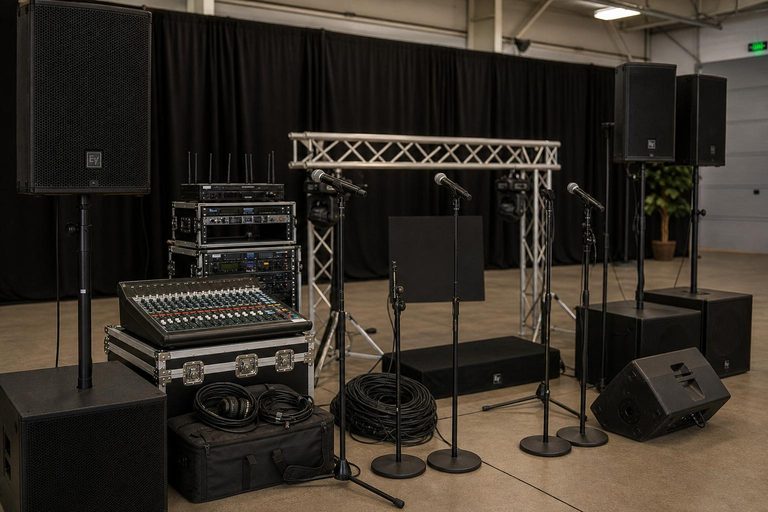
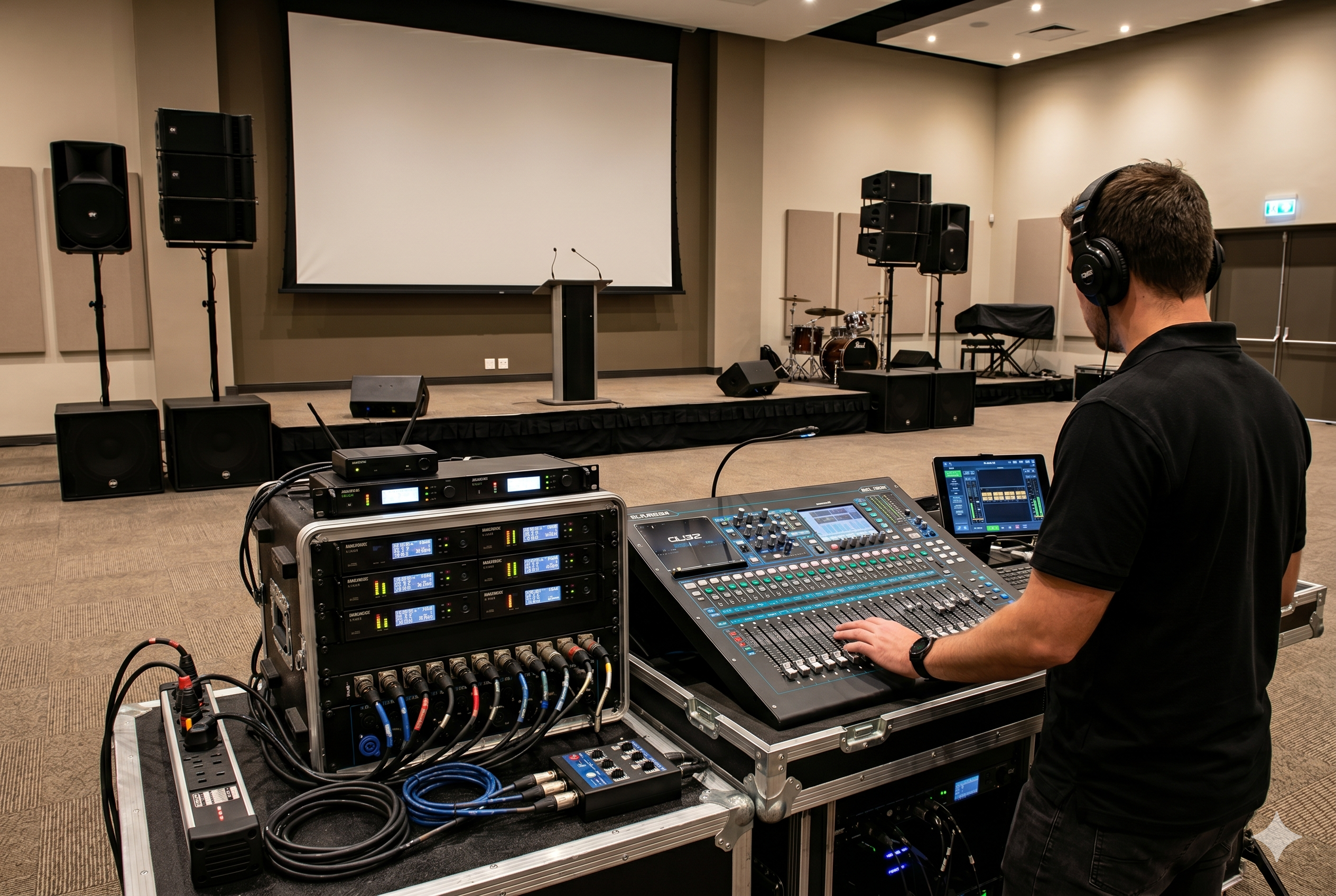
The selection of your event’s audio hardware is dictated by its specific functional requirements and the venue’s unique acoustics. We use strictly professional-grade components to eliminate noise, distortion, and potential points of failure. From corporate panel discussions to live music and top-tier DJ integration, our systems are curated for reliability, ICASA compliance, and flawless sound delivery.
To maintain audio fidelity from start to finish, we categorize our hardware into three core areas:
- Signal Capture (Microphones): We match the microphone to the sound source, utilizing sensitive condensers for lecterns and robust dynamics for handheld use. For wireless freedom without RF interference, we rely on industry-standard systems like the Shure SLXD series.
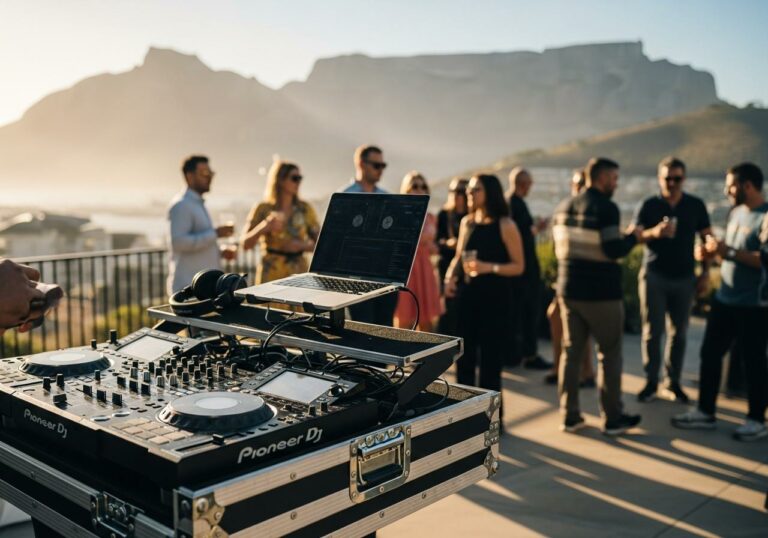
- Signal Processing & Control (Mixers & Playback): The mixing console is the control center of the operation. We utilize advanced digital mixers like the Allen & Heath QU5 and Allen & Heath CQ12, which offer powerful onboard processing, scene recall, and remote tablet control for optimizing sound anywhere in the room. For premium music playback, we deploy professional DJ controllers like the Pioneer XDJ RX3 and Pioneer XDJ Opus quad.
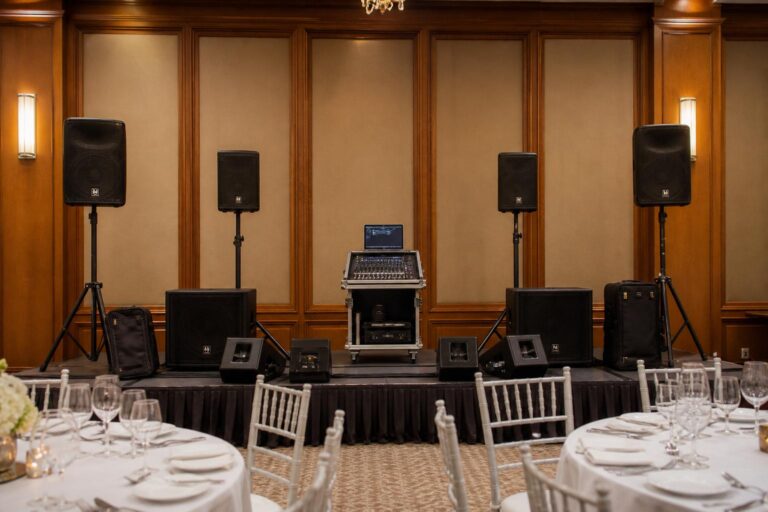
- Signal Reproduction (Speakers & PA): Your PA system must provide clear, even coverage to the entire audience. For standard-sized rooms, we deploy highly capable point-source or column systems like the RCF J8, RCF Evox 8, or RCF art912a. For larger or acoustically challenging spaces, we use the Wharfedale WLA1 line array for precise sound dispersion, adding subwoofers whenever impactful low-frequency reinforcement is required.
The Sound Check Protocol: A Step-by-Step Guide
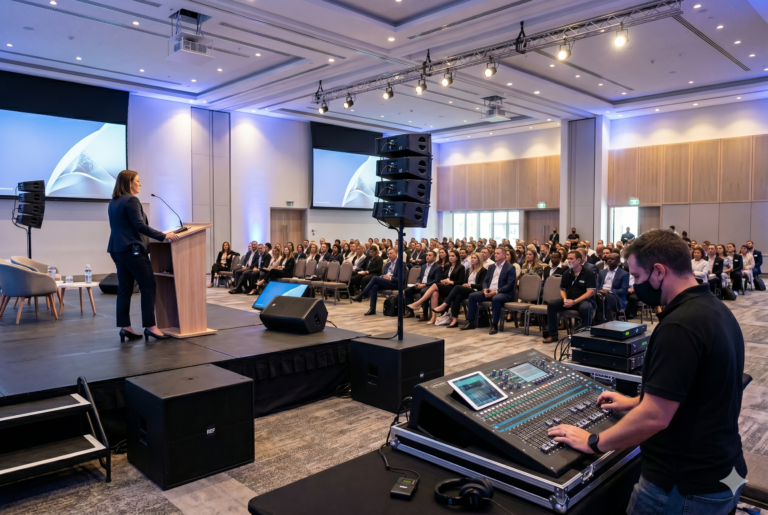
A methodical sound check is a critical technical process, not a rehearsal. Rushing or skipping is the leading cause of live audio issues. To ensure every component functions perfectly and is optimized for the venue, we first verify the physical setup against our stage plot and input list. Then, following the “Golden Rule” of checking one thing at a time to quickly isolate any faulty cables or patches, we execute a strict operational sequence to guarantee system integrity:
- System Verification: We test the PA system with pink noise to check for uniform coverage and identify any acoustic challenges in the room.
- Line Checks: We test each input individually, tracing the signal flow from the microphone through the mixing console to the speakers.
- Gain Staging: We precisely set the input gains for each channel to achieve a strong, healthy signal level without clipping or distortion.
- Front-of-House (FOH) Mix: We build the primary mix that the audience will hear, adjusting the EQ and levels for maximum clarity and balance.
- Monitor Mix: We work directly with each performer or presenter on stage to create their individual, customized monitor mix.
- Feedback Suppression: We preemptively identify and eliminate potential feedback frequencies using digital suppression tools or graphic equalizers.
Troubleshooting: Common Audio Glitches and How to Fix Them
Even with meticulous planning, technical issues can arise. The difference is in having a systematic approach to troubleshooting. Most problems can be categorised as issues with power, signal, or hardware. The first step is always to isolate the problem. Is it affecting a single channel or the entire system? A problem with a single microphone point towards the mic itself, the cable, or its specific channel on the mixer. A problem affecting the entire system is more likely related to the mixing console, amplifiers, or the main power supply. For example, a persistent low-frequency hum across the whole system often indicates a ground loop issue, which can be resolved with a ground lift on a DI box or ensuring all equipment is on the same electrical circuit. Wireless interference often manifests as pops, dropouts, or static, and is typically fixed by performing a new frequency scan and changing the channel on the wireless system.
Backup Plans: Essential Redundancy for Live Events
In a live event environment, failure is not an option. Professional audio operations are built on the principle of redundancy. A single point of failure can jeopardise the entire event, which is an unacceptable risk for our clients. Therefore, we implement backup systems for all critical components. This starts with having spare equipment on-site. We always carry extra microphones (both wired and wireless), spare cables of all necessary types, and backup DI boxes. For mission-critical presentations, we often deploy two microphones on the lectern; one primary and one backup, each running to a separate channel on the mixer. If the primary microphone fails, the technician can switch to the backup channel instantly and seamlessly. This level of preparation is standard procedure, not an optional extra.
Precision Solutions with Sonic event audio
Our methodologies are engineered for guaranteed performance and operational stability within the unique demands of the South African commercial market. We specialise in eliminating the technical variables that put events at risk. A professional consultation with our specialists ensures your audio system is not only compliant with all relevant standards like those from SABS and ICASA but is also optimised for maximum impact and reliability. Get a quote using the button below.
FAQs
What are the most common audio issues at live events?
The most frequent issues are audio feedback (a high-pitched squeal), hum or buzz from electrical interference, and wireless microphone dropouts. Feedback is caused by a microphone picking up its own amplified signal from a speaker. Hum and buzz are typically grounding issues or the result of using low-quality, unbalanced cables. Wireless dropouts happen due to RF interference or operating the system too far from its receiver.
How many microphones do I need for a 4-person panel discussion?
The standard professional setup is one microphone per person. This provides the best audio quality and control, allowing the technician to mute the microphones of panelists who are not speaking to reduce background noise. Typically, these would be either gooseneck condenser microphones attached to the table or individual lavalier (lapel) microphones.
Do I need a professional sound technician for my event?
If clear audio is important for your event’s success, then yes. A professional technician does far more than just set up speakers. They perform the critical site assessment, select the correct equipment for the venue, manage frequencies, operate the mixing console to ensure balanced levels, troubleshoot issues instantly, and manage the complex interplay between the main PA and stage monitors. Their expertise is what guarantees a flawless audio experience.
What is the difference between a line level and a mic level signal?
These terms refer to the voltage level of an audio signal. A microphone produces a very weak signal, known as “mic level.” This signal must be boosted by a preamplifier in the mixing console. Devices like laptops, smartphones, and professional audio playback equipment produce a much stronger “line level” signal. Plugging a line level source into a mic level input will overload the circuit and cause heavy distortion, while the reverse will result in a signal that is too quiet to be usable.