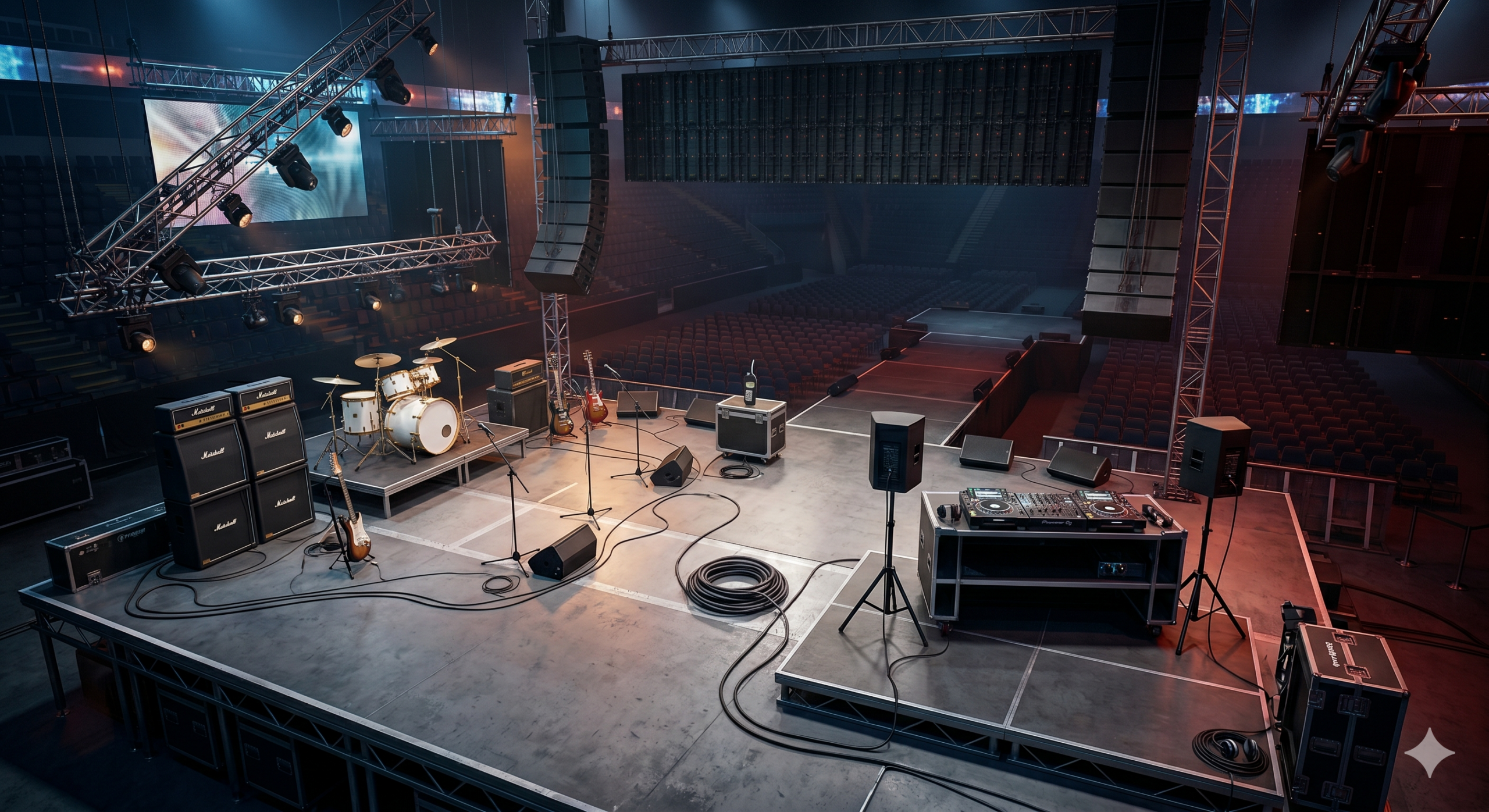
Live Band vs. DJ Sound Setup Requirements: The Ultimate Technical Guide
A live band requires a multi-channel audio system with individual monitoring, extensive backline, and a significantly larger power and stage footprint. A DJ setup is comparatively streamlined, centred on a two-channel stereo output with high-power subwoofers. Understanding these core technical divergences is fundamental to successful event production.
Understanding the Technical Rider: Key Differences Explained
The technical rider is the single most important document for differentiating between the needs of a live band and a DJ. It is a legally binding addendum to the performance contract that specifies all technical requirements. For a live band, this document is extensive and complex, detailing every piece of equipment and logistical necessity.
In contrast, a DJ’s rider is typically far simpler, focusing on booth layout, specific playback hardware (such as a Pioneer XDJ RX3 or a Pioneer XDJ Opus quad), and the main stereo connection to the house Public Address (PA) system. The core function of the rider is to eliminate ambiguity and ensure that the production team can prepare the stage and system correctly, saving immense time during load-in. An artist providing a detailed rider signals a high level of professionalism and allows the venue’s technicians to have most of the setup pre-configured before arrival.
Stage Plot and Input List
A band’s technical rider will always include two critical components:
- The Stage Plot: A visual diagram illustrating the precise placement of each musician, their instruments, backline amplifiers, and monitor speakers on stage, indicating exactly where power drops are needed.
- The Input List: A detailed spreadsheet that itemises every single sound source—from vocal microphones to instrument lines—and specifies the corresponding channel requirement on the mixing console.
While a five-piece band can easily require 16 to 24 or more input channels, a DJ typically requires only two channels on the mixer for their main stereo output (plus an optional monitor channel). This fundamental difference in channel count directly dictates the size and complexity of the mixing console and cabling infrastructure required for the event.
Space and Staging Requirements: Dimensions and Layouts
The physical footprint and staging layout required for a live band are substantially larger than those for a standard DJ setup:
- Live Band Requirements: A standard four or five-piece band requires a minimum stage area of 6 metres wide by 4 metres deep. This space is essential to safely accommodate the musicians, individual monitor wedges, and instrument amplifiers, keeping in mind that a standard drum kit alone occupies a 2 metre by 2 metre footprint.
- DJ Booth Requirements: A professional DJ booth requires a much smaller physical footprint and can be comfortably accommodated in a space as small as 2 metres by 2 metres. The primary considerations here are a stable, vibration-isolated surface for the controllers and sufficient clearance for the performer.
Backline and Monitoring
The term “backline” refers to the amplification equipment used by the musicians on stage, such as guitar and bass amplifiers. This equipment is a major component of the stage footprint. Furthermore, each musician in a band typically requires a dedicated monitor speaker (or “wedge”) to hear themselves and other specific band members. The monitor engineer creates individualised mixes for each performer, which can be a complex task involving multiple separate outputs from the mixing console. A DJ requires a much simpler monitoring setup, usually consisting of one or two high-output speakers in the booth to hear their mix clearly for beat-matching, independent of the main sound the audience hears. The distinction is between multiple, individualised monitor mixes for a band versus a single, localised monitor mix for a DJ.
Power and Electrical Needs: Preventing Circuit Overload
Power infrastructure requirements vary drastically between performance types, making a proactive assessment essential to prevent catastrophic circuit overloads:
- Live Band Power Draw: A full band’s backline, multi-channel PA system, and extensive staging rigs draw significant amperage. This setup often necessitates multiple dedicated 20-amp circuits or a comprehensive three-phase power distribution system for larger productions.
- DJ Setup Power Draw: Consisting primarily of a playback controller, a localized mixer, and a laptop, a DJ’s core booth gear features a remarkably low power draw that can typically run off a single standard circuit.
- SANS 10142-1 Compliance: To guarantee safety and legal compliance, all electrical reticulation and power distribution for events in South Africa must strictly adhere to SANS 10142-1 standards.
Dedicated Power for Audio Integrity
To ensure audio signal integrity and prevent audible hums or buzzes, it is an industry standard to run all audio equipment from dedicated, isolated power circuits. These circuits should be separate from those used for lighting displays (such as Chauvet and Beamz setups), video screens, or catering equipment. Lighting dimmers, in particular, are notorious for introducing noise into audio systems if they share a power source. For a band, this means the PA system, mixing consoles, and all backline amplifiers should be on their own clean power supply. The same principle applies to a DJ setup, ensuring the main PA and the DJ booth equipment are isolated from other electrical noise sources.
Audio Equipment Checklist: PA Systems, Mixers, and Backline
A comprehensive audio system is required for both performers, but the scale and components differ significantly. Both require a main PA system to deliver sound to the audience, ranging from a large-scale Wharfedale WLA1 line array for major events to high-quality active systems like the RCF J8, RCF Evox 8, or RCF art912a for versatile, scalable coverage.
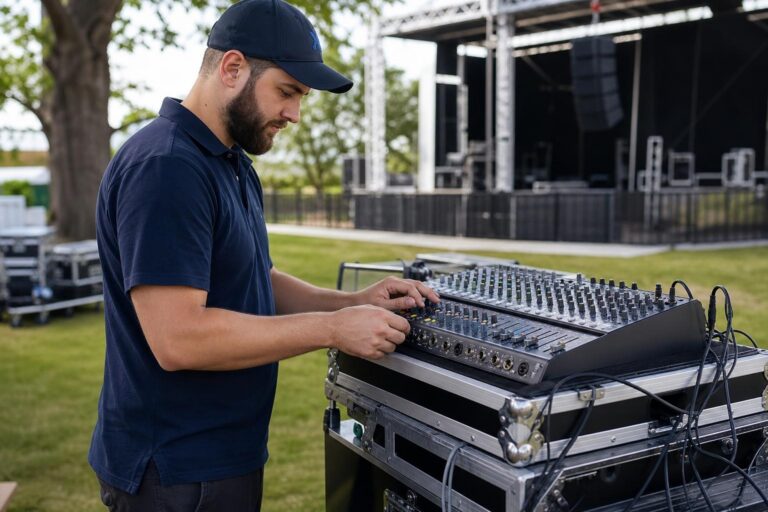
- Live Band System: Requires a multi-channel mixing console (such as an Allen and Heath QU5 or Allen and Heath CQ12), numerous microphones for vocals and instruments, direct injection (DI) boxes for electronic instruments, multiple monitor wedges, and a full backline of instrument amplifiers.
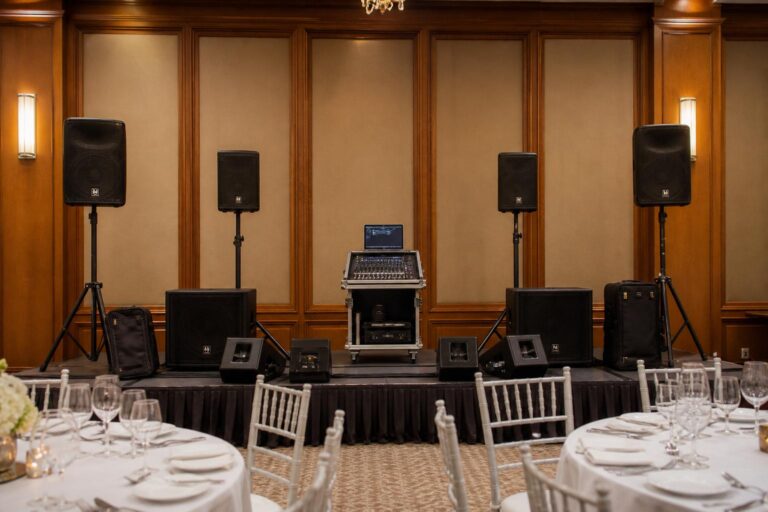
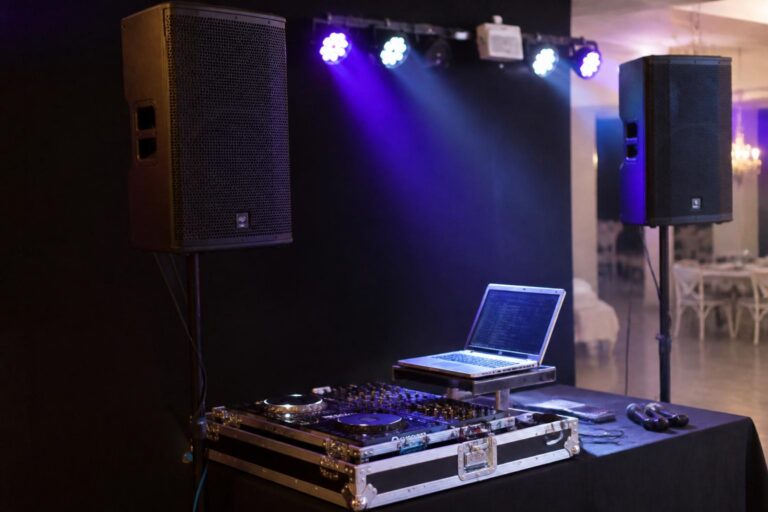
- DJ System: Requires a high-end standalone system or controller (like the Pioneer XDJ RX3 or Pioneer XDJ Opus quad), two high-quality main speakers, and one or more powerful subwoofers. The emphasis is on high-output, full-range stereo playback with significant low-frequency extension.
- Microphones: A band requires a variety of specialised microphones (such as reliable Shure SLXD microphones for wireless vocal clarity), whereas a DJ typically only needs one microphone for announcements.
Acoustic Considerations for Venues: Coverage and Volume Control
Venue acoustics profoundly impact the quality of amplified sound. Hard, reflective surfaces like glass, concrete, and brick can cause excessive reverberation, making both music and vocals sound muddy and indistinct. Effective acoustic treatment, such as installing sound-absorbing panels or heavy drapes, is vital for clarity. For a DJ, whose music is often bass-heavy, managing low-frequency build-up is a primary concern. Strategic subwoofer placement is key; corner loading can boost bass output, but often creates uneven coverage with “power alleys” and “dead zones”. Placing subwoofers centrally or in a carefully calculated array can provide more even bass distribution throughout the listening area.
Sound Pressure Level (SPL) Management
Managing volume is a critical responsibility. For live bands, the on-stage volume from amplifiers and the drum kit can be very high, which the FOH engineer must balance with the PA system. The goal is to achieve a clear, impactful mix without reaching unsafe sound pressure levels (SPLs). For DJs, the challenge lies in delivering powerful bass without it overwhelming the rest of the frequency spectrum or becoming distorted. Professional audio systems use limiters and compressors to control peaks and protect both the equipment and the audience’s hearing. Adherence to local noise regulations is mandatory, and a professional sound technician will use an SPL meter to monitor levels throughout the event, ensuring a safe and enjoyable experience.
Let Sonic Event Audio Handle Your Setup Requirements
Our expertise ensures your event’s audio is engineered for its specific purpose, whether it’s the multi-layered complexity of a live band or the high-impact delivery of a DJ set. We specialise in providing systems that meet the precise demands of technical riders, ensuring flawless execution and compliance with all South African safety standards. We analyse your venue and power infrastructure to design a solution that guarantees optimal performance and signal integrity. Get a quote using the button below.
FAQs
How much electrical power does a 5-piece live band require compared to a DJ?
A 5-piece live band, with individual amplifiers, a full PA system, and stage monitoring, can require several separate 20-amp circuits. A DJ setup, in contrast, typically needs only a single standard 15-amp circuit for their controller, mixer, and laptop. The primary power draw for a DJ comes from the main PA system’s amplifiers, which is a shared requirement.
What are the minimum stage dimensions needed for a full live band setup?
For a standard 4 to 5-piece band, a minimum stage area of 6 metres wide by 4 metres deep is recommended. This provides adequate space for the drum kit, amplifiers (backline), microphones, monitor speakers, and allows the performers safe room to move.
Can a DJ plug into a live band’s mixing console?
Yes, a DJ can connect to a band’s mixing console. This is a common feature of hybrid events. The DJ’s mixer output would be connected to two available line-level input channels on the main console, allowing the FOH engineer to control the DJ’s volume and integrate them into the overall sound mix.
What is a “backline” and who is responsible for providing it?
“Backline” refers to the instrument amplifiers (guitar amps, bass amps) and the drum kit that are positioned at the rear of the stage. The responsibility for providing the backline is specified in the artist’s technical rider. Sometimes the band travels with their own equipment; other times, the event organiser is required to rent it locally to exact specifications.