How to Choose the Right Sound System for Outdoor Events: A Comprehensive Guide
An effective outdoor audio solution is determined by a correct analysis of the venue, accurate scaling for the audience’s size, and the selection of appropriately robust system components. The primary methodologies involve deploying either a line array system for large, dispersed crowds or a point source setup for more contained areas. Success depends on strategic speaker placement and secure, compliant power management.
Assessing Your Venue: Space, Layout, and Acoustics
Your first action must be a technical assessment of the event space. Outdoor venues present unique challenges that are entirely absent from indoor environments; there are no walls or ceilings to contain and reflect sound energy. This means audio dissipates rapidly. You must analyse the following key factors:
- Topography and Obstacles: Note any hills, slopes, or natural amphitheatres that can aid dispersion, as well as buildings or dense trees that might block sound.
- Ambient Noise: Account for high noise floors near busy roads, airports, or the ocean, which require higher-powered systems to ensure intelligible audio above background interference.
- Ground Surface Acoustics: Consider if the surface is grass (which absorbs sound) or hard pavement (which reflects sound and creates unwanted echoes).
A thorough site survey allows us to map out the audio coverage requirements and identify potential dead zones or areas of unwanted sound concentration.
Determining the Scale: Guest Count and Audio Requirements
The scale of your event, defined primarily by the guest count, directly dictates the required power and configuration of the sound system. The core principle is to provide clear, undistorted sound to every person, from the front row to the very back. System requirements generally scale in three stages:
- Small Gatherings (up to 50 guests): A simple point source system consisting of two high-quality active speakers on stands is usually sufficient for background music and speeches.
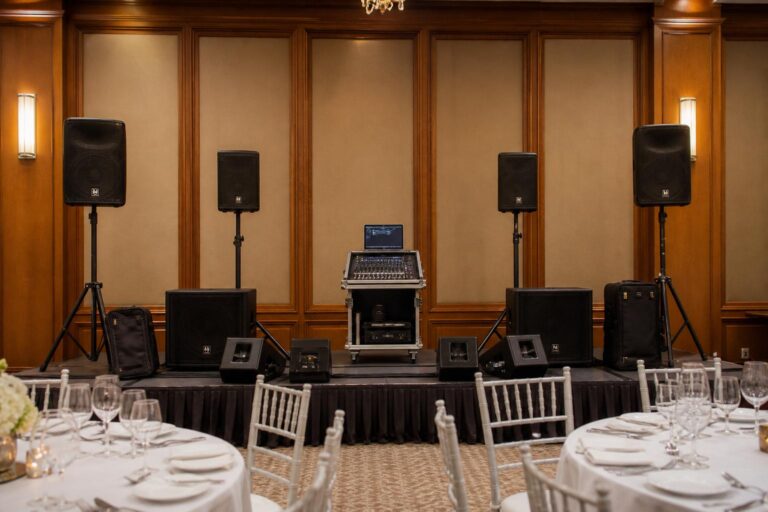
- Medium Events (150-250 guests): Weddings or corporate functions require a more substantial setup with larger main speakers and at least one subwoofer to handle low-frequency content for full-range musical reproduction.
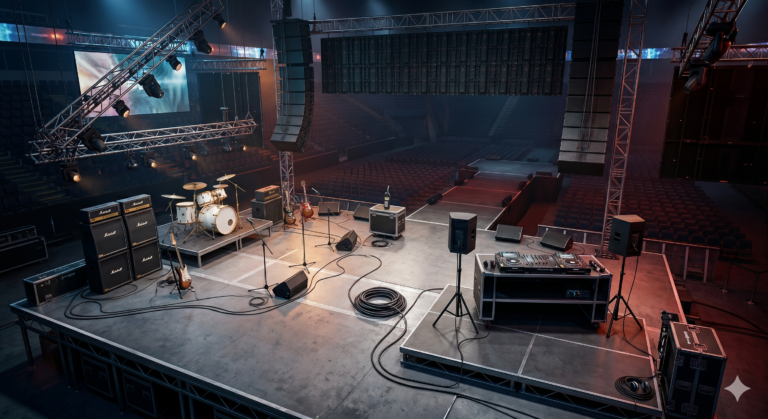
- Large-Scale Events (Thousands of attendees): Concerts and festivals demand complex line array configurations and significantly higher wattage to provide necessary headroom for high-energy live music without distortion.
We calculate the necessary power output, measured in watts, based on a “watts-per-person” guideline, which varies depending on the type of audio being reproduced; speech requires less power than live music. For outdoor events, a general rule is to double the wattage you would use for a similar-sized indoor event to compensate for the lack of sound reflection.
Speech versus Musical Performance
The audio requirements for spoken words are vastly different from those for musical performances. For conferences, public addresses, or ceremonies, the primary objective is intelligibility. The system must be calibrated to clearly reproduce the frequencies of the human voice, cutting through any ambient noise. This often involves using directional microphones and careful equaliser adjustments.
For musical events, the system must be capable of reproducing the full spectrum of frequencies, from the deep bass of a kick drum to the crisp highs of cymbals. This necessitates a more complex system, including subwoofers for low-end reinforcement and potentially a line array of speaker configuration for even coverage over a large area. The required power for a concert is significantly higher to provide the necessary headroom for musical dynamics without clipping or distortion.
Key Components of an Outdoor Sound System
A professional outdoor sound system requires specialized, weather-resistant gear built to withstand moisture, dust, and temperature fluctuations while delivering reliable, interference-free audio.
- Speakers: Weather-resistant active or passive tops and subwoofers (e.g., RCF J8, Evox 8, or art912a) for clear, powerful point source coverage.
- Amplifiers: Specifically matched the power handling requirements of any passive speakers used.
- Audio Mixers & Sources: Robust digital or analogue desks (e.g., Allen & Heath QU5 or CQ12) or professional DJ standalones (e.g., Pioneer XDJ RX3 or Opus Quad) for high-fidelity signal control.
- Microphones: Reliable wired or wireless systems (e.g., Shure SLXD) equipped with appropriate windscreens for environmental resistance.
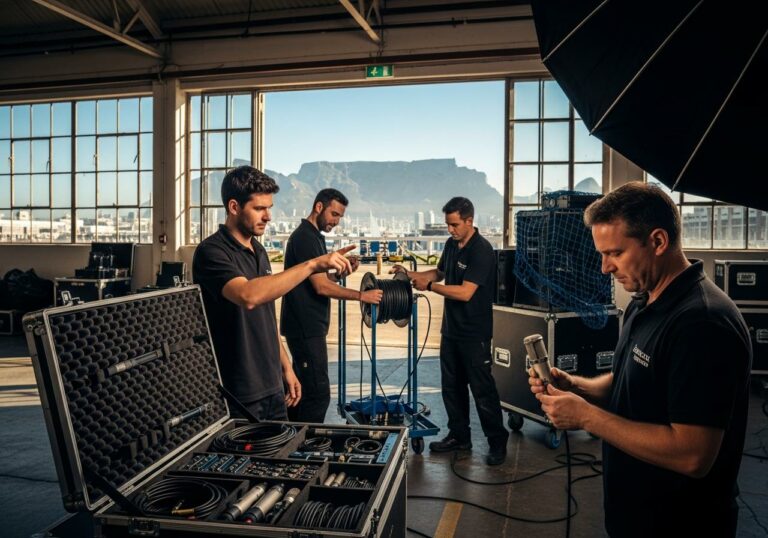
- Cabling: Shielded XLR signal cables, outdoor-rated speaker wire, and heavy-duty power extensions to ensure interference-free connectivity.
Technical Specifications to Look For
When selecting equipment, you must look beyond brand names and focus on key performance specifications. For outdoor applications, the two most important metrics are power output, measured in both wattage and decibels (dB), and weather resistance, indicated by an Ingress Protection (IP) rating. Wattage indicates the power an amplifier can produce, or a speaker can handle, but it doesn’t tell the whole story about loudness. The speaker’s sensitivity rating (dB SPL produced from 1 watt at 1 metre) is equally important; a more sensitive speaker will produce a higher volume with less power.
Understanding these figures is essential for designing a system that can achieve the required sound pressure level (SPL) for your audience size and venue without being pushed into distortion. Furthermore, since the equipment will be exposed to the elements, its durability is non-negotiable. An IP rating provides a clear, standardised measure of protection against solid objects and liquids.
Weather Resistance and IP Ratings
Any equipment used outdoors must be designed to withstand environmental hazards. The Ingress Protection (IP) rating system is an international standard that classifies the level of protection an enclosure provides. The rating consists of two digits indicating protection against solids like dust (first digit, 0-6) and liquids (second digit, 0-9). When evaluating gear, keep these benchmarks in mind:
- IPX4 Minimum: Recommended for most standard outdoor events, offering protection against splashing water from any direction.
- IP65 or Higher: Essential for events where heavy rain is possible. This rating ensures the unit is completely dust-tight and can withstand low-pressure water jets.
We exclusively use equipment with appropriate IP ratings to guarantee operational reliability regardless of the weather.
Strategic Speaker Placement for Maximum Coverage
Effective speaker placement is a science that ensures clear and balanced audio throughout the entire listening area. The primary goal is to maximise direct sound to the audience while minimising unwanted reflections and sound loss. For most events, the main speakers should be placed on sturdy stands on either side of the stage, elevated above the heads of the audience. This allows the sound to travel over the first few rows and reach the back.
The horizontal and vertical dispersion angles of the speakers, a key technical specification, determine how wide and tall the sound coverage pattern is. For wide audiences, speakers with a broad horizontal dispersion are used. For long, narrow venues, a more focused pattern is required. Point source speakers are effective for smaller, more defined spaces, while line array systems are superior for large areas as they provide a more controlled, long-distance projection with less volume drop-off over distance.
Line Array vs. Point Source Speakers
The choice between a line array and a point source system is determined by the venue size and coverage requirements. A point source system, typically a single speaker or a small cluster, radiates sound in a wide, spherical pattern. This is ideal for smaller events where the audience is relatively close to the stage. However, in larger venues, this wide dispersion can lead to inconsistent coverage and sound hitting unwanted surfaces.
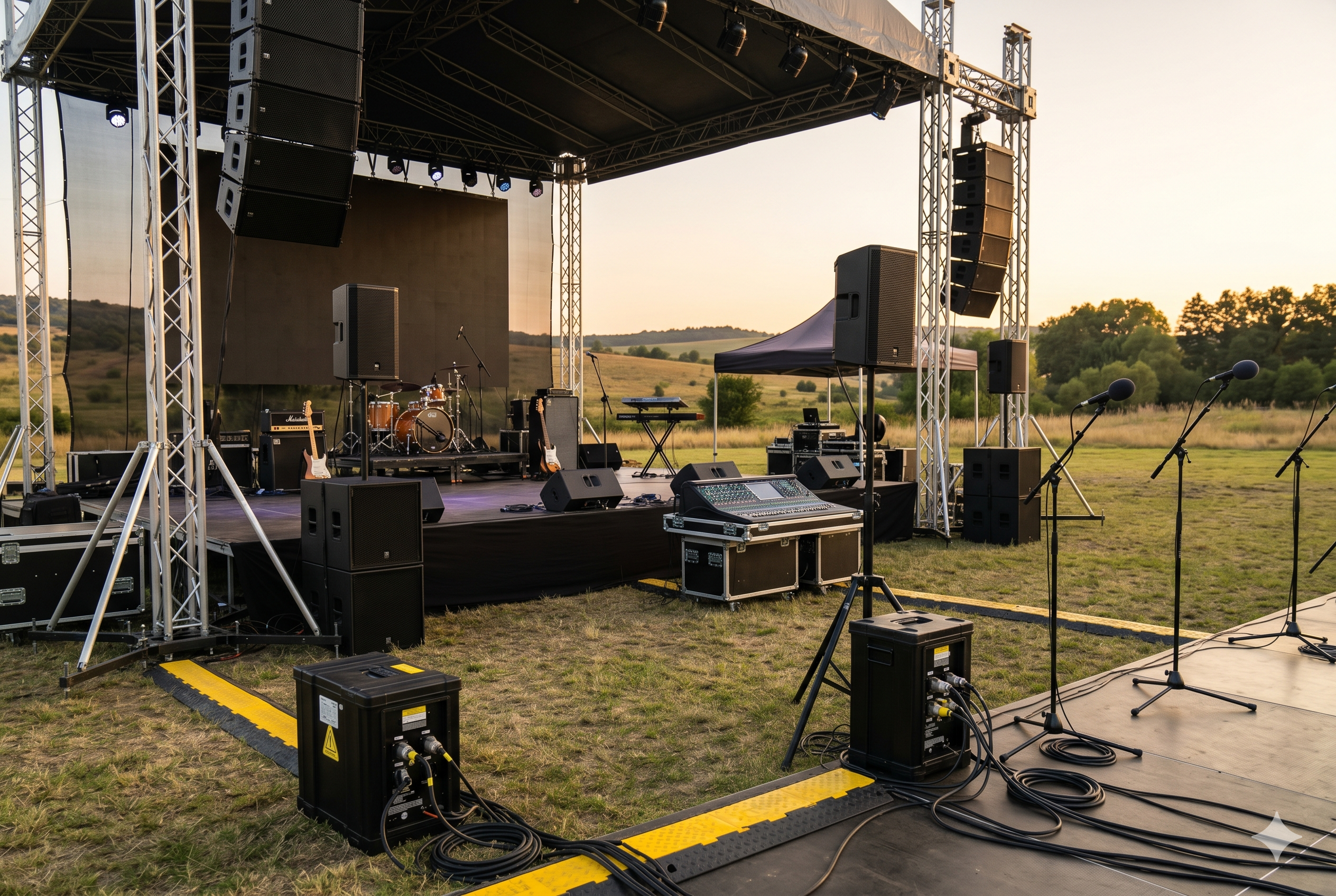
A line array system, such as the Wharfedale WLA1 line array, consists of multiple identical speaker elements stacked vertically. This configuration creates a more controlled, cylindrical wave front that can be precisely aimed. This focused energy allows sound to travel much further with greater clarity, making line arrays the standard for concerts, festivals, and large corporate events where even sound pressure levels must be maintained from the front to the back of the crowd.
Power Supply and Cable Management for Outdoor Safety
Providing a stable and safe power supply is a critical logistical component of any outdoor event. Professional sound systems can draw a significant amount of electrical current, especially large amplifier racks and active speakers. All power distribution must adhere to strict safety standards to prevent electrical hazards. Our safety protocols include:
- Stable Power Sourcing: Utilizing verified, sufficient venue power or deploying calibrated, silenced generators.
- SANS 10142-1 Compliance: Adhering strictly to South African national standards for the safe wiring of premises and electrical installations, utilizing distribution boxes with proper earth leakage protection.
- Secure Cable Management: Laying heavy-duty, outdoor-rated cables through high-visibility, non-slip trunking and ramps to protect equipment and eliminate tripping hazards for guests and crew.
Let Sonic Event Audio Help You Choose the Right Sound System
We provide engineered audio solutions, not just equipment rentals. Our systems are designed for guaranteed performance and precision within the demanding South African commercial environment. We ensure every component, from the microphones to the power distribution, is specified for optimal utility and complies with all relevant safety standards. A professional consultation is the most effective way to align your event requirements with a reliable and cost-effective technical solution. Get a quote using the button below.
FAQs
How many watts do I need for an outdoor event of 100 people?
For an outdoor event of 100 people where background music and speech are the focus, a system with a combined power output of approximately 500 to 1,000 watts is a safe starting point. If the event involves a live band or DJ playing at high volumes, you should plan for 1,000 to 2,000 watts to ensure sufficient headroom and avoid distortion.
Can I use indoor speakers for an outdoor party?
We strongly advise against using indoor speakers for outdoor events. Indoor speakers are not designed to withstand moisture, dust, or temperature changes, and they can be easily damaged. Furthermore, they are acoustically designed for enclosed spaces and will not project sound effectively in an open-air environment, resulting in poor sound quality and coverage.
How do you prevent sound from drifting in windy conditions?
To combat wind, we increase the overall system volume to maintain clarity and may use more speakers in a distributed arrangement to reduce the distance sound has to travel. Utilising line array speakers is also highly effective, as their focused dispersion pattern is less susceptible to being “blown away” than the wider pattern of point source speakers. For microphones, we always use high-quality foam windscreens and may opt for directional headset mics to minimise wind noise.
Should I rent or buy a sound system for my event?
For a one-off or infrequent event, renting is almost always the better operational and financial decision. Professional audio equipment is a significant capital investment and requires specialised knowledge for transport, setup, and operation. Renting from a reputable company like ours gives you access to high-end, properly maintained equipment and the technical expertise of our engineers, ensuring your event’s audio is managed professionally.